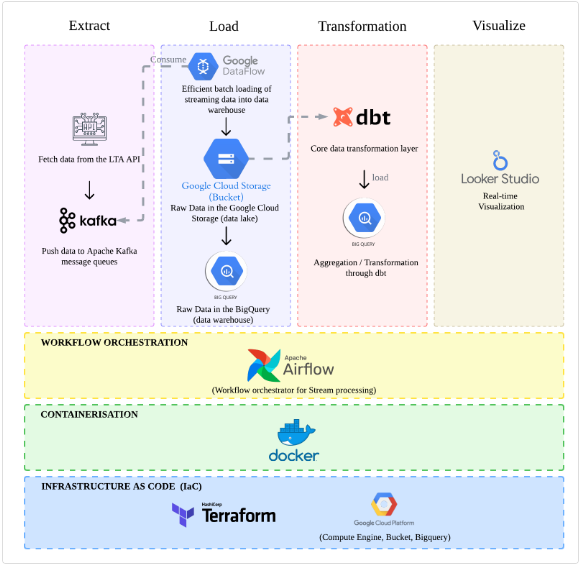
Hi, from 12th of January I plan to start learning great course on Data Engineering from Data Talks Club. It is of very high quality and free, so it’s a win-win. Plus you get a certificate if you manage to do properly the final assignment. It was recommended to me by a very knowledgeable colleague who is an experienced Data Engineer.
This course has a Slack channel for all the people who are doing it at the same time. In case you are interested in doing it shoot me a message and let’s try to do it together!
I’ve recently completed and passed the C10 LLM Foundations Certified PM certificate by The Product Compass.
This is the foundational module of The Product Compass’s AI PM Learning Program, designed to give product managers a solid understanding of large language models (LLMs) – both technically and strategically.
What the Certificate Covers
The C10 module focuses on LLM fundamentals – how these models work, where they fit in the AI landscape, and how they can be applied in product management.
The exam consists of 20 multiple-choice questions, and you need about 80% to pass. After this foundation, the next level is C11 – LLM Practitioner, where the focus shifts to hands-on work such as building LLM-based products, implementing RAG systems, and fine-tuning models.
This credential verifies that you understand the core mechanics, potential applications, and management considerations of LLM-driven products.
Knowledge Areas Covered
Here are the main domains the certificate focuses on:
1. Fundamentals of LLMs and AI Technologies Neural networks, transformers, self-attention, tokenization, and reinforcement learning. Understanding how LLMs fit into modern AI stacks.
2. Prompt Engineering How to design and structure prompts, create templates, and optimize model outputs while managing limitations.
3. APIs and Integration Patterns Connecting LLMs via APIs, handling completions, streaming, and tool calls. Emphasis on product implications and system integration.
4. Context Engineering, RAG, and Memory Building Retrieval-Augmented Generation (RAG) workflows with vector stores, embeddings, and data chunking. Creating memory architectures for better model context.
5. Fine-Tuning and Model Adaptation Covers SFT, RLHF, and other fine-tuning methods like DPO and ORPO. Focuses on when to use fine-tuned vs. general-purpose models.
6. Evaluation and Observability How to monitor and measure LLM performance – from hallucination rate and bias to safety and efficiency.
Why It’s Worth Taking
What I liked about this certificate is that it moves beyond the hype and focuses on what actually matters when building or managing AI products – understanding not just how LLMs work, but how to integrate them responsibly and effectively.
It’s a great entry point before diving into the more practical C11 Practitioner level, which includes real-world applications and hands-on projects.
Here is a Summary of a new Guide coming from the Project Management Institute that is helping us as AI Technical Project Managers lead the transformation of organizations using AI.
Overview
This guide offers a strategic roadmap for integrating artificial intelligence (AI) into organizational operations, with a focus on the roles of the Project Management Office (PMO), project professionals, and Transformation Management Office (TMO). It provides practical strategies to drive AI adoption, manage change, and achieve measurable business value.
The Benefits of AI Adoption
Enhanced decision-making – AI driven analytics can provide predictive insights that improve strategic decisions across organizations
Increased efficiency and productivity – AI automates repetitive tasks such as data processing, reporting and project scheduling
Enhanced customer experience – AI technologies like chatbots and personalized marketing enable companies to provide timely and relevant services
Scalability – AI systems handle large-scale tasks more efficiently than manual processes. As companies grow, AI enables them to scale operations by automating tasks and providing analytics that facilitate expansion without requiring proportional increases in the workforce
Improved risk management – AI powered risk management tools analyze past project performance data to predict potential risks, helping the organization mitigate issues before they arise
Agility and innovation – AI helps organizations stay ahead by providing real-time insights into market changes, allowing them to react faster to evolving business environments
Cost reduction – AI reduces costs by automating labor-intensive tasks, optimizing resource use and ensuring smoother workflows
Talent augmentation – AI does not replace human talent but complements it. By handling tedious or time-consuming tasks, AI enables employees to focus on creative, strategic work. This augmentation of human capabilities is especially valuable for knowledge workers in industries like project management
Better project outcomes – AI’s abilities to provide accurate forecasts, optimize resource planning and monitor performance contribute to better project outcomes
Competitive advantage – Organizations that adopt AI early position themselves as industry leaders driving innovation and efficiency. AI adoption is increasingly seen as a critical factor for companies seeking a sustainable competitive advantage
Understanding the AI Adoption Life Cycle
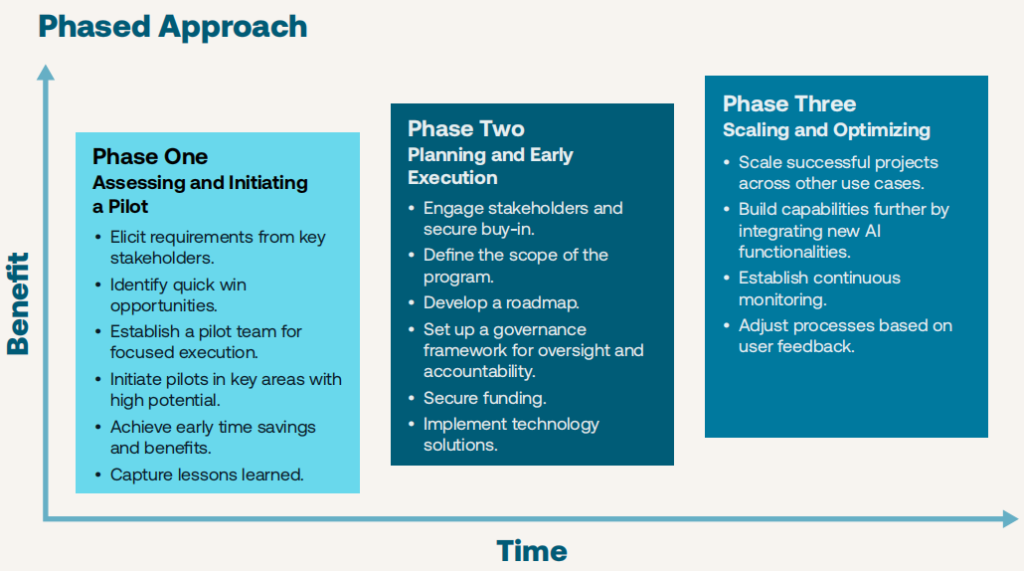
Exploration and Strategy (Initiation)
support leadership in defining the business case for AI
conduct initial feasibility studies, market research and risk assessment
identify key stakeholders
evaluate the availability and quality of data
need for specialized AI talent
develop mitigation strategies for AI specific risks:
data bias
model accuracy
regulatory compliance
Consider:
ethical considerations
integration of ML models into existing systems
impact of AI models on business models and operations
Planning and Design (Planning)
ensure clear goals, timelines, budgets and success metrics
define scope
design project charters
resource allocation
create AI adoption roadmaps
plan integration of data pipelines
development of AI models
continuous monitoring and refinement of these models
Pilot and Implementation (Execution)
monitor AI project execution against predefined goals
track progress
manage resources
ensure AI projects are delivered on time and within scope
ensure AI project is continuously evaluated for it’s impact on data quality and model performance
ensure project plans include strategies for:
data validation
model tuning
integration of AI into existing systems
Evaluation and Optimization(Monitoring and Controlling)
conduct post-implementation reviews that specifically assess the AI model’s accuracy, reliability and ethical implications of AI models
gather feedback from users to understand the real-world impact of AI and monitor the return of investment (ROI) using AI analytics to predict future performance and identify areas for optimization
adjust plans and strategies based on these insights to ensure continuous improvement
Scaling and Institutionalization (Closure)
manage documentation, knowledge transfer and lessons learned
Data-Related Challenges
Data Quality
establishing standards, metrics and reporting processes
check data is clean, accurate and consistent
Data Accessibility
data could be stored in various areas and proper shareholders should have access to it
remove barriers to data flow across departments
Data Governance
establish and implement data governance policies and standards ensuring data quality, security and compliance are maintained throughout the project life cycle
Data Privacy
enforce data privacy policies and compliance frameworks ensuring all AI projects adhere to legal and regulatory requirements
Data Integration
cross department data integration efforts
Technological Issues
Model Complexity
manage the development, testing and tuning of complex models
focus on the strategic implications of model complexity making sure they are scalable and aligned with future AI initiatives
Scalability and Performance
ensure AI systems can grow without compromising performance
optimize models to ensure they can handle increased loads, larger data sets without sacrificing efficiency
Business Strategy
ROI Measurement
establish metrics, track performance and ensure alignment with business objectives and long-term goals
track project-specific outcomes, costs and benefits
Prioritization
set criteria for evaluating AI projects and align with strategic goals
assess timelines, resources and stakeholder expectations, helping to ensure high-impact AI projects are executed first
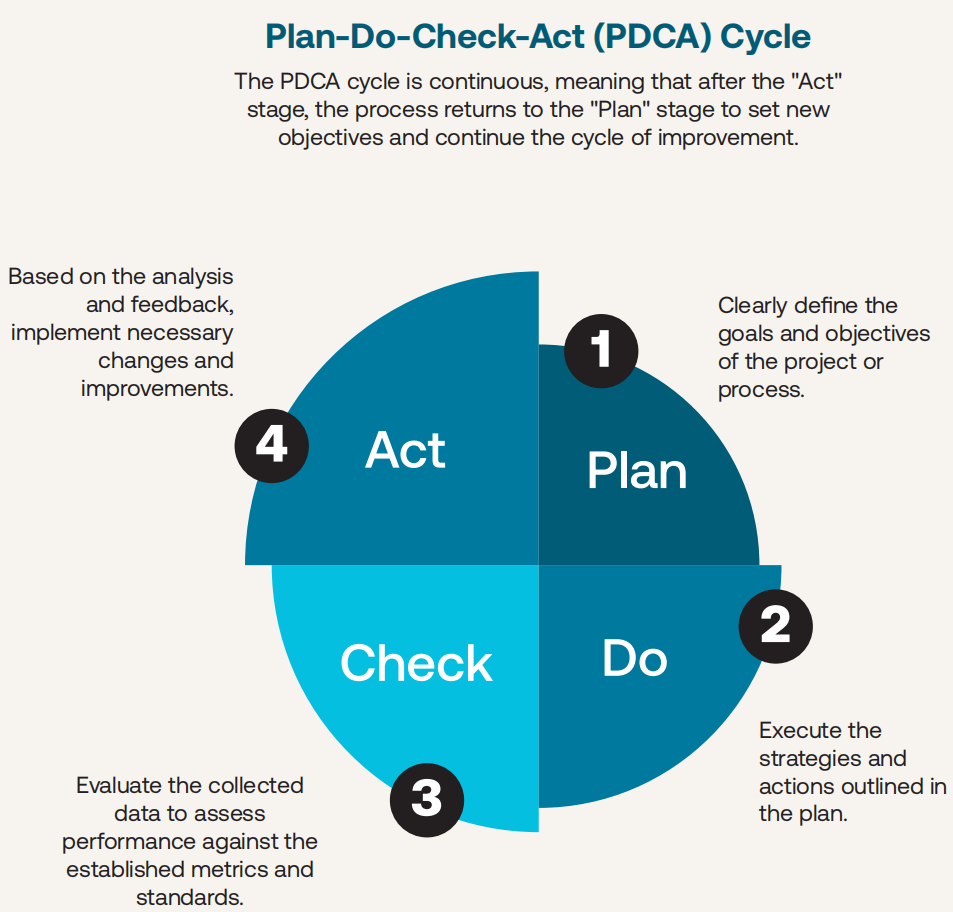
Adopting the Plan-Do-Check-Act Method for Continuous Improvement
Kef Activities:
Plan improvements
Implement changes
Check results
Act on findings
Review impact
Iterate continuously
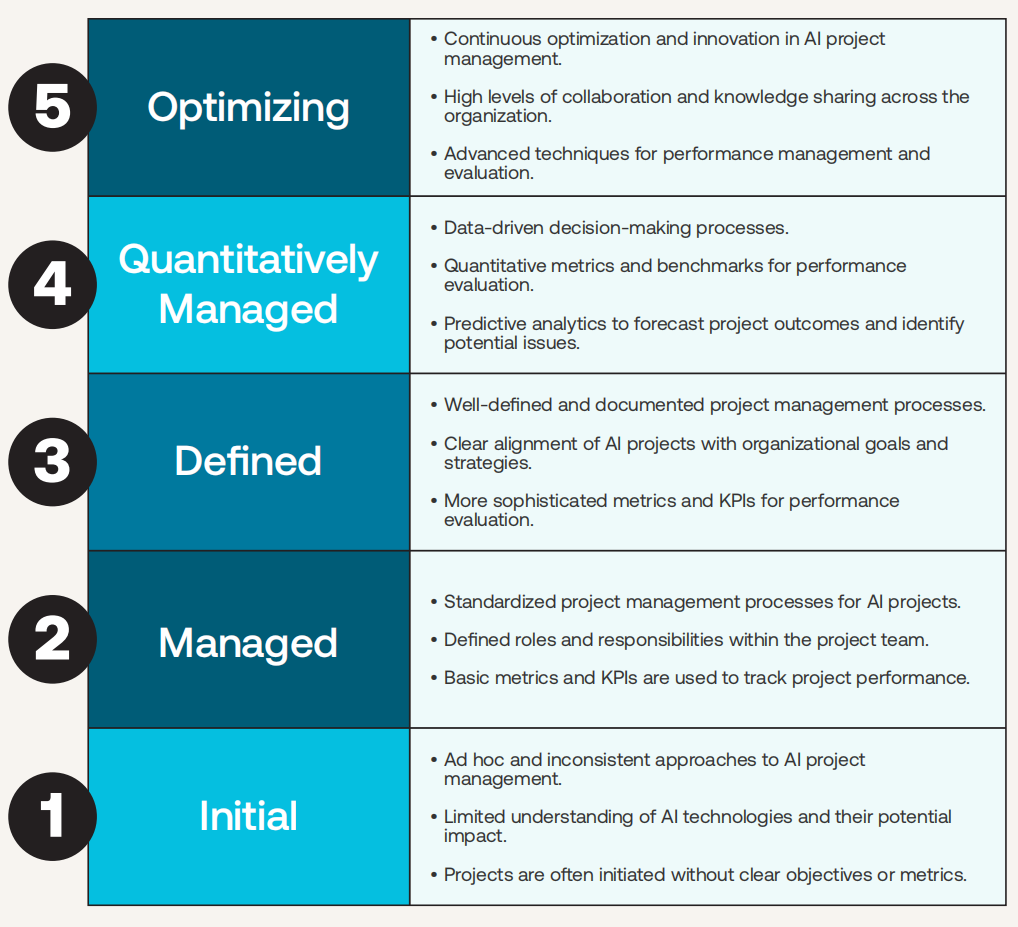
The AI project maturity model
Aligning With Organizational Goals
Conduct a thorough analysis of the organization’s strategic objectives and business priorities
Identifying specific AI initiatives that can directly support organizational goals
Engaging with key stakeholders
Developing a clear roadmap
Establishing a process to monitor and adjust the AI strategy
Leading Cros-Functional Teams to Drive AI Adoption
Establishing clear roles and responsibilities
Facilitating effective communication
Setting clear goals and milestones
Promoting collaboration and knowledge sharing
Managing stakeholder expectations
Addressing conflicts and challenges
Monitoring and adjusting the project plan
Managing Stakeholder Expectations and Communication Throughout the AI Life Cycle
Identifying key stakeholders
Establishing clear communication channels
Defining expectations early
Regularly updating and reporting
Addressing concerns and feedback
Educating and informing
Managing change
Celebrating successes
AI Vendor Management
Selecting vendors
Creating clear contracts and SLAs that outline scope, deliverables, timelines, performance metrics and payment terms
Ensuring vendor tool compatibility
Onboarding and integrating
Regularly communicating and meeting
Monitoring performance and feedback against the agreed-upon SLAs
Managing risk
Collaborating and knowledge sharing
Establishing a contract renewal and exit strategy
Identifying and prioritizing AI Use Cases
Conducting a business needs assessment
Evaluating organization’s current AI capabilities
Identifying potential use cases
Scoring and prioritizing use cases
Conducting feasibility studies for high-priority use cases
technical assessments
cost-benefit analyses
risk evaluations
Creating a roadmap
Securing stakeholder buy-in
Monitoring and adjusting
Upskilling and Reskilling the Workforce
Conducting skills gap analysis
Developing training programs
Providing continuous learning opportunities
Creating mentorship programs
Encouraging cross-functional collaboration
Measuring training effectiveness
Aligning training with business objectives
Conclusion
Similar to most publications coming from PMI this book is also “dry” and theoretical and is trying to cover many cases and therefore not being specific. However it gives a list of things that are to be taken into account when transforming the organization to implement AI of which I have taken out the most important here.
It is giving a great beginners all round picture about AI and AI projects. Here are some 5 minutes read takeaways to inspire you to check the course:
AI projects should be viewed as R&D projects
Unlike typical software projects where we are used to more exact Scope, Timelines and Cost expectation, with AI projects that is harder the case. What represent them much more are:
uncertain timeline
uncertain budget
uncertain result precision
The areas where AI is used are:
Natural language processing
Computer vision
Speech recognition and
Robotics
Types of AI
Machine learning uses statistics. Deep Learning uses artificial neural networks.
Deep learning is more expensive, so with little amount of data use ML as it is cheaper and gives equal results
Supervised learning – show the machine what you want it to do Unsupervised learning – models learn on their own without the need oof labeled data by finding patterns and commonalities
Supervised learning works best when you know what the outcome would be.
Unsupervised learning works best when you don’t know what the outcome will be
Reinforcement learning is when you give the end goal and set of rules, but no labeled data
When should AI be used
When a human expert can give response in few seconds
When it is hard to define exact rules of the problem solving
When it is easy to get examples of the desired behavior – get labeled data
The AI Canvas (questions to answer)
PREDICTION – What do you need to know to make the decision?
JUDGEMENT – How do you value different outcomes and errors?
ACTION – What are you trying to do?
OUTCOME – What are your metrics for task success?
INPUT – What data do you need to run the predictive algorithm?
TRAINING – What data do you need to train the predictive algorithm?
FEEDBACK – How can you use the outcomes to improve the algorithm?
Data collection methods
Next to a proper model second most important thing for AI project to succeed is the data the we train the model with. These are the data collection methods:
Open data
Company data
Crowdsourcing labeled data
New feature data
Acquisition or purchased data
There was also introduced a concept of MVD which stands for Minimum Viable Data (needed to train the model in order to develop an AI product)
Managing AI projects
An example of Kanban board states for an AI project:
Data Backlog – when Datasets are ready
Data Processing – preparing and cleaning the Data
Data Modeling – building Models with clean data
Model Training – train and retrain models to reach requirements
Testing – test the trained Model
Deployment – deploying the Model on production environment
Monitoring – monitoring Model performance
Done – celebration 🙂
Data & AI team roles
Data/AI Product Manager – determines which products to build
Data Scientist – builds AI models and conducts advanced data analysis
ML Data Engineer – develops and maintains the ingestion of data, data infrastructure, data warehousing and data pipeline
The End
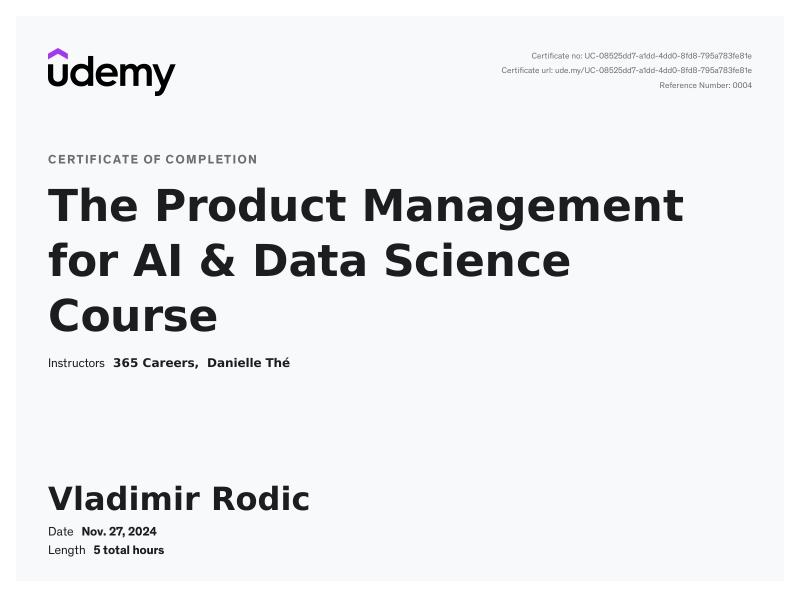
I hope you enjoyed the summary of this course and that it has inspired to you to check it out. It was very well worth it for understanding the basics of AI projects.
Which course or learning material would you like to share with me?